Google is great, and sometimes over-efficient. So – with my almost obsessive research into Wearable Technology, I find myself assaulted with ads on a daily basis – here’s why I like it – I get to see – without any research on my part – how brands are choosing to capture my attention. Here’s one from a fitness tracker “…does what Apple Watch and FitBit can’t do”. Me – pause for one second – click corner – banish ad. I get it, its early days, but I find myself hoping that some wearables don’t descend into a “look at my features” mayhem and stay there so long that the value of how they can actually fit into our world dissipates into oblivion.
I find myself reflecting on the pivotal moment in 1997 that Jobs announced that Apple would not be going down the features and product-centric route. Yes, this isn’t news and we’ve heard the story before – but its pretty pertinent given the noise in today’s marketplace. I would hope that we all learned some good lessons from Apple’s success.
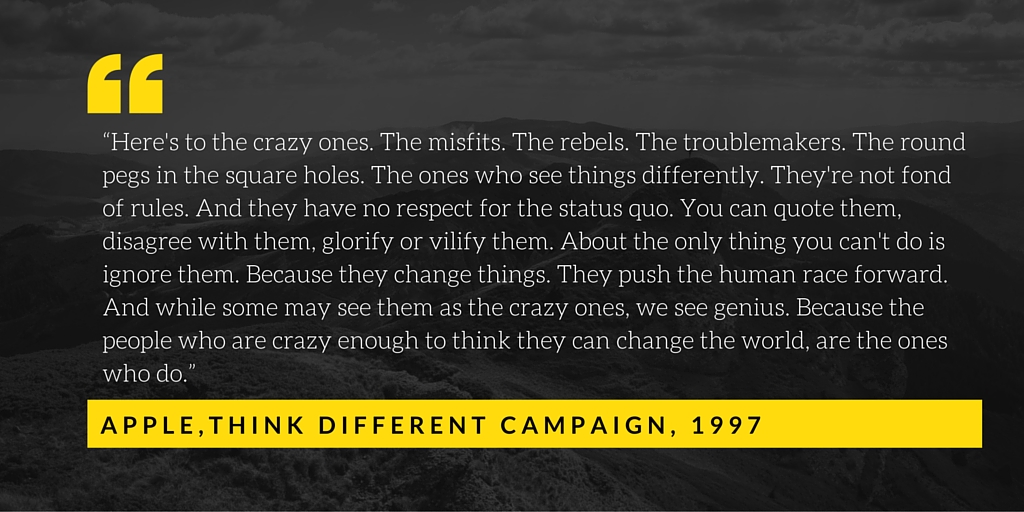
Taking the lead from Nike’s emotional marketing campaigns, Jobs unveiled a campaign that was an inspiring celebration of 17 icons who had dared to “Think Different“. That campaign was relevant to all of us, across cultures, countries, sexual orientation and religion. And here’s what Jobs had to say:
“I know that some people will criticize us for not talking about all those things about why we have better plug and play, but, we’ve got to let people know who Apple is, and why its still relevant in this world”
Im not sure about you but unless I tried terribly hard I wouldn’t see why I would buy one fitness tracker versus the other or one smart watch versus another – there are enough deliciously differing features on offer that bear a striking similarity to one another – heart rate monitor, step counter, sleep monitor. I would however be inclined to purchase any thing with an “i” infront of it.
With all the extra noise and the big focus on “All Things Tech” and “Internet of Things”- it’s tempting for players in this space to try and differentiate based on a new or richer feature set. Differentiation on that basis is a dauntingly dangerous premise, in the next few months – there will surely be another new feature set. What then?
Then of course there’s breaking-even, that ever important dollar sign that has the ugly potential of shackling brands to their business goals, pushing them to succumb to the “look at me” phenomenon. And that “look at me” phenomenon has a very clever way of seeping into the very fabric of company culture.
It is clear that wearables are still struggling to find relevance in our lives, however what isn’t clear is whether we will see campaigns that actually engage our emotions, motivating us to find the relevance, rather than attempting to win us over with logic. Because falling in love isn’t about logic.
What Jobs did back then was pretty risky – Apple was on the brink of financial failure – “logically” the natural route would have been to focus on products, sales and business goals. It’s a trap many organizations fall into. But Apple, instead, focused on storytelling around emotions and ambitions.
And so now, here we are, 2016, not only were Apple able to sell us a computer, then a phone, and a TV, it is now a watch, and wait a second – our wallets too. Welcome to the world of Apple Pay.
Not everyone will tell a story like Apple, but for however narcissistic Jobs was painted out to be, he certainly didn’t transfer that onto the brand….despite the “i” being ever present in its products.
So here’s a few key take aways for newer entrants – step away from the features trap, know who you are, tell people who you are and engage in a way that is authentic and will be relevant today and tomorrow. Help people fall in love with you.

 Saira Mullick